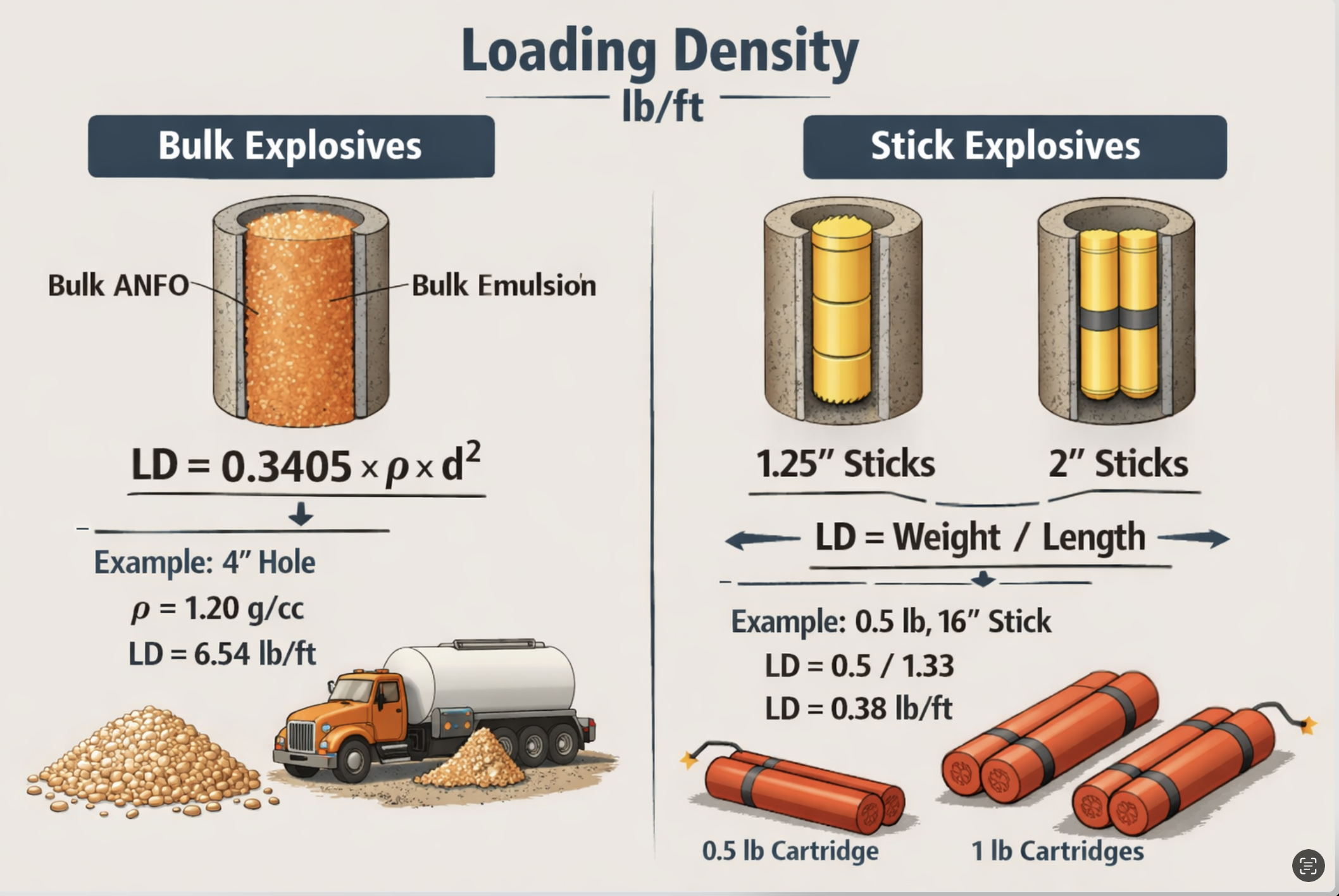
Introduction to Loading Density for Blasters
How to Calculate It and Use the PETS Toolbox Calculator
Loading Density (LD) is one of the most useful calculations in blast design. It tells a blaster how much explosive is loaded into each foot of a borehole, usually in pounds per foot (lb/ft). In simple terms, it shows how much explosive energy is placed along the length of the hole. PETS describes it as a fast way to sanity-check a loading plan, compare products and diameters, and document what was actually loaded in the field.
The basic equation is:

This number matters because it helps determine total explosive in the hole, powder factor, energy distribution in the rock, vibration control, and fragmentation performance. When loading density is too high, a blast can create excessive vibration, flyrock, overbreak, and compliance problems. When it is too low, the result may be poor rock breakage, large boulders, and incomplete fragmentation.
PETS explains that loading density is especially useful because it is independent of hole length. That makes it easier to compare one product or loading method to another without getting lost in total pounds per hole. It is also helpful when switching between bulk and packaged explosives, changing diameters, dealing with coupled versus decoupled charges, or checking decked holes one segment at a time.
Two Main Ways Explosives Are Loaded
In practical blasting, explosives are generally loaded in two main forms: bulk explosives and stick or cartridge explosives. Bulk explosives include products such as ANFO, emulsion, and heavy ANFO. These are pumped or poured into the hole and, when fully coupled, the effective charge diameter is usually the borehole diameter. Cartridge explosives are packaged products, such as dynamite or water-gel cartridges, and the effective charge diameter is the cartridge outside diameter because the charge is decoupled from the hole wall. PETS specifically notes that mixing up borehole diameter and cartridge diameter is one of the most common loading-density mistakes.
That difference is important. For bulk products, the explosive usually fills the hole, so the loading density is much higher. For stick explosives, the cartridge is often smaller than the hole, leaving an air gap. PETS points out that decoupling reduces the effective cross-sectional area and therefore reduces the linear load, even when the product density stays the same.
What You Need Before Using the PETS Calculator
According to PETS, before opening the Loading Density calculator you should have four key items ready: the explosive product density as supplied or as loaded, the effective charge diameter, the charge column length per deck if the hole is decked, and the units you want to use such as lb/ft or kg/m. PETS also recommends treating each deck separately first if you are loading decked holes, then rolling the totals together later for documentation.
The PETS Toolbox loading-density workflow is straightforward. First select units. Second, enter the explosive density. Third, enter the charge diameter. Fourth, enter charge column length if the tool is set up to calculate more than just linear load. Finally, read the results, which commonly include loading density and, when length is included, charge per deck or charge per hole.
Example: Using PETS for a Bulk Emulsion Hole
Suppose a blaster is loading a borehole with bulk emulsion and the calculator returns a loading density of 6.54 lb/ft. If the explosive column length is 20 ft, the total charge per hole is:
Two Ways Explosives Are Loaded into Boreholes
In blasting operations, explosives are typically loaded into boreholes in one of two ways: bulk explosives or cartridge (stick) explosives. Each method requires a slightly different approach to calculating loading density.
Bulk Explosives
Bulk explosives include materials such as ANFO, bulk emulsion, and heavy ANFO mixtures. These explosives are pumped or poured directly into the borehole, completely filling it from wall to wall. Because the explosive fills the entire borehole, the loading density depends mainly on two factors:
-
the diameter of the borehole
-
the density of the explosive
Bulk explosives generally create higher loading densities because the entire borehole is filled with explosive material.
Stick Explosives (Cartridges)
Stick explosives are packaged explosives that come in individual cartridges. Examples include dynamite sticks and water-gel cartridges. Unlike bulk explosives, cartridges are usually smaller than the borehole diameter, leaving a small air space around the explosive. This condition is called decoupling, meaning the explosive does not fully contact the borehole wall. Because of this, loading density for stick explosives is calculated using:
-
cartridge weight
-
cartridge length
instead of the borehole diameter.
Example: 3.5-inch Borehole with 3-inch Stick Explosives
In many blasting operations, the borehole is drilled slightly larger than the explosive cartridge.For example:
-
Borehole diameter: 3.5 inches
-
Explosive cartridge diameter: 3 inches
Since the explosive cartridge is slightly smaller than the hole, a small air gap exists between the explosive and the rock. This means the explosive is decoupled from the borehole wall.
Calculating Loading Density for Stick Explosives
For cartridge explosives, loading density is calculated as the weight of the cartridge divided by its length.

Example Calculation
Assume a typical 3-inch explosive cartridge has:
-
Weight: 2 lb
-
Length: 16 inches = 1.33 ft

This means that every foot of the borehole contains about 1.5 pounds of explosive.
Coupling Ratio: How Tight the Explosive Fits
Another useful concept in blasting is the coupling ratio, which describes how closely the explosive fits inside the borehole.
The coupling ratio is calculated as:

For this example:

A coupling ratio of 0.86 means the explosive nearly fills the hole but still leaves a small air space. This slightly reduces the pressure transferred from the explosive to the surrounding rock.
Calculating the Total Explosive in the Hole
Once the loading density is known, it is easy to determine the total explosive weight in the borehole.
The formula is:

Example
If the explosive column length is 20 feet:
Total = 1.50 x 20 = 30 lb
This means the borehole contains about 30 pounds of explosive.
Why Blasters Use Loading Density
Blasters use loading density to help design safe and effective blasts. Knowing the loading density allows them to calculate:
-
the total explosive weight in each hole
-
the powder factor
-
the charge weight per delay
-
expected vibration levels
Proper loading density helps ensure that the explosive energy is distributed correctly in the rock. This improves fragmentation while reducing unwanted effects such as vibration and flyrock.
Summary
Loading density describes how much explosive is placed in each foot of a borehole. It is a key value used in blast design.
Bulk explosives completely fill the borehole, so their loading density depends on the hole diameter and explosive density. Stick explosives are smaller than the borehole, so their loading density is calculated using the cartridge weight and cartridge length.
In a 3.5-inch borehole loaded with 3-inch stick explosives, a typical cartridge weighing 2 pounds and measuring 16 inches long produces a loading density of about:
1.5 pounds of explosive per foot of borehole.
Understanding loading density helps blasters design safer, more efficient blasts and achieve better rock fragmentation.